Helen Mary Elizabeth Paterson was born on 26 September 1848, at Swadlincote in Derbyshire, the daughter of Alexander Henry Paterson, a medical doctor, and Mary Herford Paterson. Helen was the eldest of seven children. The year after her birth the family moved to Altrincham in Cheshire. In 1862 her father and her three-year-old sister Isabel died of diphtheria during an epidemic. The remaining family then moved to Birmingham, where some of Alexander Paterson’s family lived.
Paterson showed a talent for art from an early age, drawing some of her inspiration from her maternal grandmother Sarah Smith Herford and aunt Laura Herford, both accomplished artists of their day. Her younger sister Caroline Paterson also became a noted artist. She initially studied art for three years at the Birmingham School of Design. She went to London and spent a year at the Royal Female School of Art in London, before following her aunt Laura Herford to the National Art Training School. In 1867 she enrolled in the Royal Academy School, which would later become the Royal College of Art. There she was particularly influenced by the work of Birket Foster & Fred Walker
While studying at the National Art Training School, Paterson worked as an illustrator, eventually deciding to give up her studies in favour of a full-time career in art. She painted for children’s and adult books, as well as for periodicals, including The Graphic newspaper. One highlight was her commission to provide twelve illustrations for the 1874 serialisation of Thomas Hardy’s novel Far from the Madding Crowd in Cornhill Magazine. Her illustrations from this era were signed either “H. Paterson” or “H. Allingham”. She became a lifelong friend of Kate Greenaway whom she met at evening art classes at the Slade School of Fine Art.
While Vincent van Gogh was developing as an artist by studying English illustrated journals he was struck by Paterson’s work in The Graphic. Although females could not gain the same recognition as men at the time, Helen Allingham was one of the women artists who made a considerable impact, as artists like Van Gogh were influenced by her.
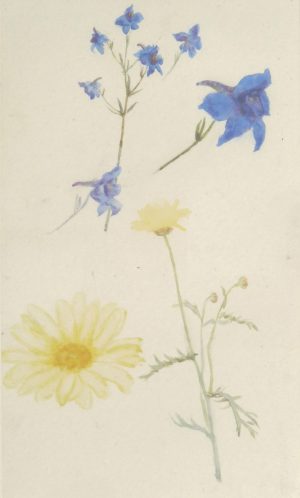
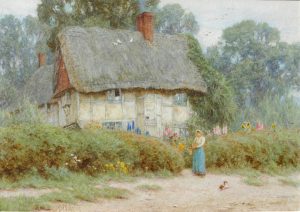
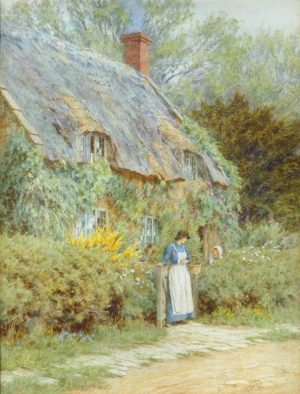
On 22 August 1874 she married William Allingham, Irish poet and editor of Fraser’s Magazine, who was almost twice her age. This placed her at the centre of the Cheyne Walk set. After her marriage, she gave up her career as an illustrator and turned to watercolour painting. In 1881 the family moved from Chelsea to Witley in Surrey. Helen started to paint the countryside around her and particularly the picturesque farmhouses, cottages and gardens of Surrey and Sussex, for which she became famous.
In 1889, her husband died. At age 41 she felt the pressure to support her 3 young children and stepped up the production of watercolour. These were done with great attention to detail and avoiding any sense of squalor or hardship. They became wildly popular. She went on to paint rural scenes in other parts of the country – Middlesex, Kent, the Isle of Wight and the West Country. She visited Venice, Italy in the spring of 1868. As well as landscapes, she completed several portraits, including one of Thomas Carlyle.
She was elected ARWS in 1875, & when in 1890 full membership was open to ladies she was immediately promoted, becoming the first woman to be admitted as a full member of the Royal Watercolour Society. At the 1893 World’s Columbian Exposition in Chicago, Illinois she exhibited her work at the Palace of Fine Arts. Examples of her work are in the BM, VAM, City AG, Manchester, Maidstone Museum, and Ulster Museum.