Narwhal and Cachalot or Spermaceti Whale
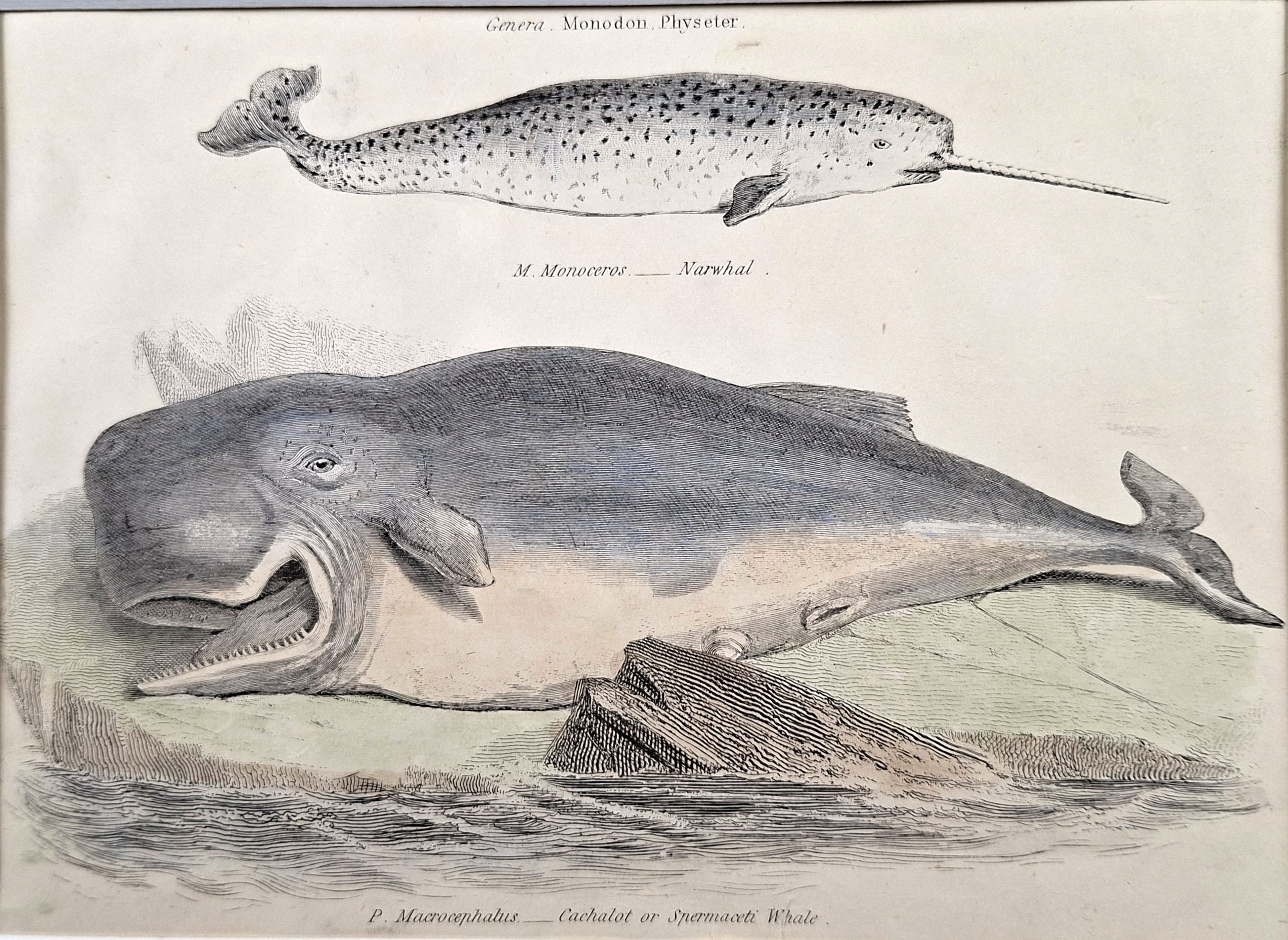
This early 19th-century natural history engraving provides a historic visual classification of marine megafauna. The finely detailed plate depicts species from the Monodon and Physeter genera, capturing the era’s fascination with deep-sea creatures during the height of the global whaling industry. Masterfully composed, the artwork serves as an important bridge between zoological documentation and decorative antique art.
The print features a side-by-side comparative layout of two iconic cetaceans. Placed at the top register is the M. Monoceros, or Narwhal, famously known as the “sea unicorn.” It is depicted with its signature elongated, spiraled tusk and characteristic mottled skin patterning.
Anchoring the lower half of the composition is the P. Macrocephalus, identified here as the Cachalot or Spermaceti Whale (Sperm Whale). The creature is shown stranded on a rocky coastline, dynamically illustrating its massive square snout, unique lower jaw structure, and distinctive blowhole placement.
The engraving stands out for its crisp cross-hatching and expressive line work, rendering the textures of the skin and coastal rock formations with incredible scientific accuracy for its time. Each subject is systematically indexed with its formal Latin nomenclature alongside its traditional English common names.
This exceptional plate is beautifully preserved, displaying light, authentic edge-toning that accentuates its vintage provenance.
Contact us on 01935 814465 or use the form below.