He was a distinguished German painter whose career spanned several major art capitals of the early 20th century. Born in 1870 in Stuttgart to a wealthy family of French descent, he received an elite artistic education. He began his studies at the Munich Academy under Gabriel von Hackl before moving to Paris to train at the prestigious Académie Julian. There, he worked under the guidance of Jean-Joseph Benjamin-Constant and the famous academic painter William-Adolphe Bouguereau, mastering the technical foundations of figure and portrait painting.
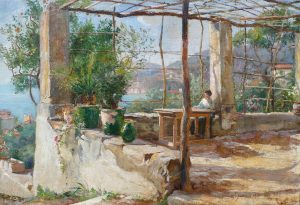
Around 1901, Brougier moved to England, where his career began to flourish on the international stage. Settling in London and later near High Wycombe, he became a regular exhibitor at the Royal Academy Summer exhibitions and was elected a member of the Royal Society of British Artists. While his early training was rooted in the strict traditions of European academia, his time in England saw his style evolve. He began to embrace a more atmospheric, impressionistic approach, using broader brushwork and a more vibrant palette to capture the nuances of light and weather.
In his final decade, Brougier sought the clear light and dramatic scenery of the American West, moving to Santa Barbara, California. During this period, he became captivated by the rugged beauty of the Santa Ynez Mountains and the coastal landscape. He spent his remaining years painting these vistas, often featuring the region’s iconic eucalyptus trees and canyons. Today, his work is valued for bridging the gap between old-world European technique and the bright, open-air traditions of early California Impressionism.