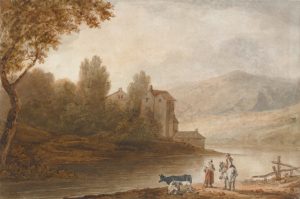
He was a distinguished figure in the British Golden Age of landscape painting. Born into a prominent artistic family, he was the son of the animal painter Benjamin Barker the Elder and the younger brother of Thomas Barker, the famed “Barker of Bath.” While his brother pursued more diverse subjects, Benjamin dedicated his career almost exclusively to the English and Welsh countryside, becoming one of the most respected regional landscape artists of the early 19th century.
Based in the fashionable city of Bath, Barker developed a style that blended the “picturesque” movement with the grand classical traditions of the Old Masters. His compositions often reflect the influence of Gaspard Poussin and Salvator Rosa, characterized by atmospheric lighting, dramatic natural forms, and a meticulous attention to the topographical details of the British landscape. His work was highly sought after by contemporary collectors and was a regular fixture at the Royal Academy and the British Institution between 1800 and 1831.
Barker’s technical mastery in both oils and watercolours earned him a lasting legacy in British art history. In 1824, his impact was further solidified with the publication of English Landscape Scenery, a collection of forty-eight of his views engraved in aquatint by Thales Fielding. Today, his paintings are preserved in major public institutions, including the Victoria and Albert Museum and the National Museum of Wales, serving as elegant windows into the pastoral beauty of the Regency era.