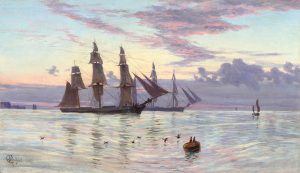
He was a distinguished Victorian landscape and marine painter, born on 15 February 1829 in Bristol. The son of Canon Knight, he was raised in an environment of intellectual and religious tradition, but his personal interests were drawn toward the sea. Before fully committing to an artistic career, he served as a midshipman on a merchant vessel destined for Calcutta. This formative period at sea provided him with an intimate, first-hand understanding of maritime life, ship rigging, and the complex movements of the ocean, all of which would become the cornerstone of his professional legacy.
Upon returning to England, Knight transitioned into formal art education at the Bristol Academy, where he began exhibiting his work. His historical significance is largely tied to his participation in the London art scene, where he was a frequent contributor to major institutions. Between 1857 and 1895, he exhibited over thirty paintings at the Royal Academy and nearly eighty at the Suffolk Street Galleries. His career coincided with the height of the Victorian era, a time when coastal scenery and naval subjects were in high demand among the growing British middle class.
Knight’s artistic style was defined by a meticulous attention to detail and a profound sensitivity to atmospheric light. He was particularly celebrated for his portrayals of the Bristol Channel and the coastlines of Wales and Devon. Unlike many of his contemporaries who favored romanticised, stormy seascapes, Knight often focused on the serene and technical aspects of maritime life. His 1861 work, The Stone Walls of Old England, showcased his ability to render geological textures and coastal light, earning him significant critical acclaim and cementing his reputation as a master of the English landscape.
Throughout his later years, Knight continued to produce high-quality oils that served as a record of a vanishing era of sailing vessels. He died in January 1897, leaving behind a body of work that remains highly regarded for its accuracy and atmospheric beauty. Today, his paintings are preserved in prestigious public collections, including the Tate Britain and the Bristol Museum and Art Gallery, standing as a testament to his skill in blending technical maritime knowledge with the aesthetic demands of Victorian fine art.