Claude Buckle was interested in art from an early age. He attended Grammar school in Wolverhampton and on leaving in 1922 joined J. S. Fry & Sons Chocolates in Bristol as an assistant architect. During his time with Fry’s he was involved in the building of the new factory at Keynsham Somerdale and was supported by Fry’s to study Architecture at Bristol University. He lived at Keynsham and Kent Road Bishopston in Bristol.
Early career
In 1926, at the age of 21, Buckle moved to London where he joined Wallis, Gilbert and Partners responsible for building the Ford factories at Dagenham.
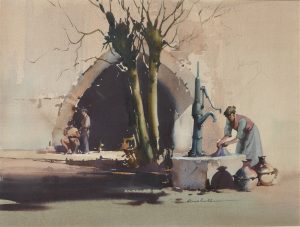
Buckle painted in his spare time. In 1930, after submitting four drawings, became one of the youngest amateur members of the British Savages Art Group based in Bristol. He contributed to the yearly exhibition until 1934. He travelled in France, Spain and North Africa using Tramp Steamers recording scenes that later formed many of the ideas for his watercolour paintings.
At the age of 26 he left full-time employment to concentrate his efforts as a professional freelance commercial artist. He undertook commissions including hotel brochures and book illustrations.
Railway posters
In 1932 he obtained his first railway poster commission at the Southern Railway HQ at Waterloo station from a Mr. Beaumont and later other commissions through the publicity offices of the Southern Region under the P.R.O Don Falkner.
This was Buckle’s big break and during the pre-war years and after the war until 1963 Buckle produced some estimated 85 posters and 25 carriage prints for the railways making him one of the most prolific and recognized railway poster artists. He was a close friend of Terence Cuneo whom he met frequently on travels around England recording scenes for the railway posters that were a common site on railway station platforms and booking halls. Both artists have surviving artwork in the National Railway Museum. However, when the work started to dry up in 1963, following the Beeching Axe, Buckle relied more and more on the private market place to earn a living. On the advice of Cuneo, he moved away almost entirely from oil painting to concentrate his efforts on watercolours.
Architect
During the war years, he worked as an architect with the bomb disposal and rescue unit based at Old Kent Road. Like many others, he witnessed terrible scenes of death and destruction in bombed London. Buckle spent the last years of the war in Northern Ireland producing architectural plan and supervising the construction of aerodromes for American bombers.
Post-WWII
In 1946 he married Barbara and found appreciative support and happiness. Two years later, he moved from the outskirts of London to a small hamlet, Vernham Dean in North Hampshire, where his twin children Terence and Barbara were born. He resumed both commercial painting and engineering architectural perspectives as well as fine art oil and watercolour paintings.
From 1958 onwards, Buckle concentrated on watercolour particularly water scenes. The Royal Institute of Painters in Water Colours, the Federation of British Artists, the Marine Society and the London Boat Show exhibited the pictures in their galleries from 1958 onwards. In 1962, Buckle accepted an invitation to become a member of the Royal Institute of Painters in Water Colours (RI) and in 1964 accepted membership of the Royal Society for Marine Artists (RSMA). Buckle also sold many paintings through private galleries and was in demand by private collectors and admirers. He also allowed printing companies to reproduce certain pictures—notably Medici and Royle’s. The full-scale lithographic reproductions were distributed to High Street retailers for example Fenwick. He also held sales of his work in Marlborough, Wiltshire, and London and in his studio at Vernham Dean. He produced an estimated 300 watercolour paintings.
Travel in France and Spain
Buckle particularly enjoyed holidays in France and Spain, enjoying the relaxed atmosphere of recording French and Spanish scenes that he later completed in the Studio at Vernham Dean. He visited France and Spain nearly every year from 1952 until 1973 which gave him the main source of inspiration for his watercolour paintings. He spent much time during the later years of his life on the Île de Ré at Rivedoux. The pictures depicting the scenes of this area are some of his best watercolours.