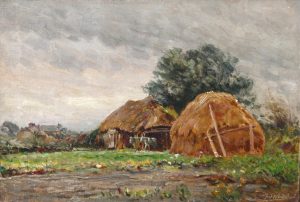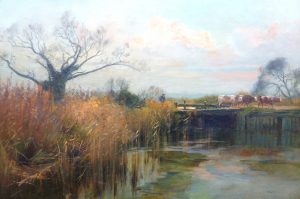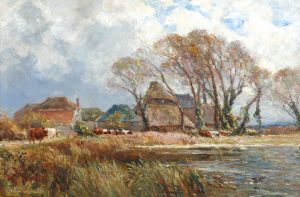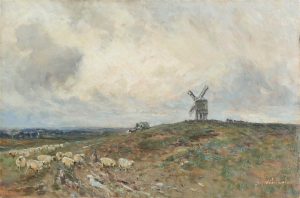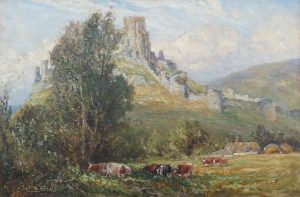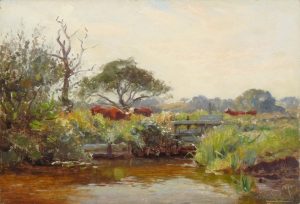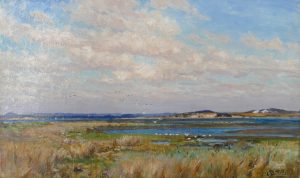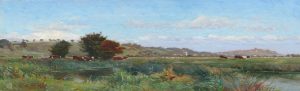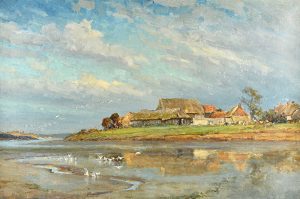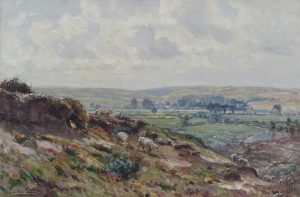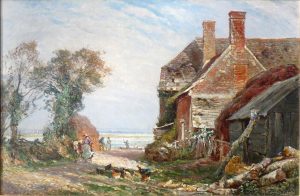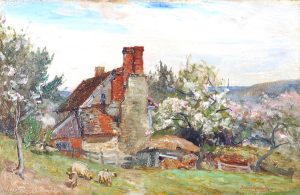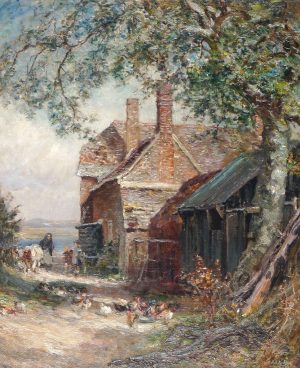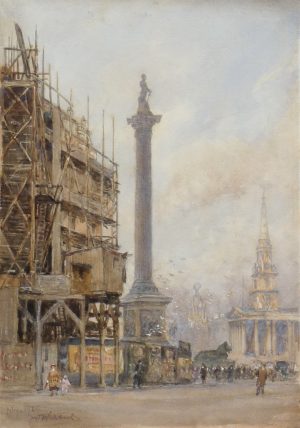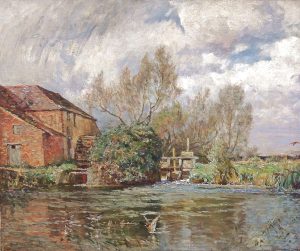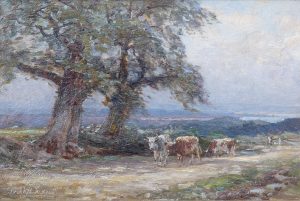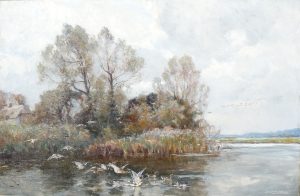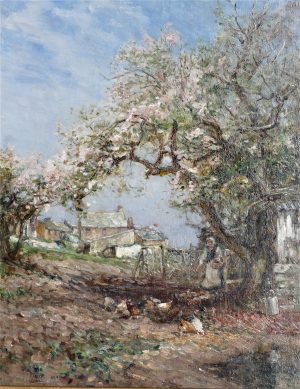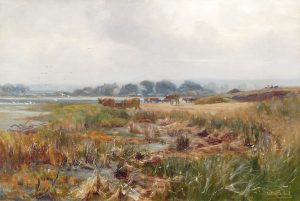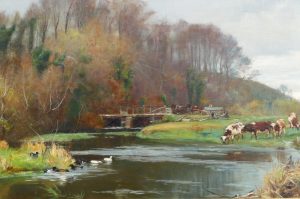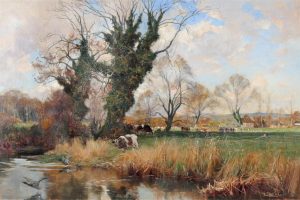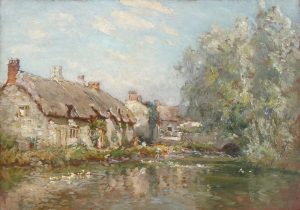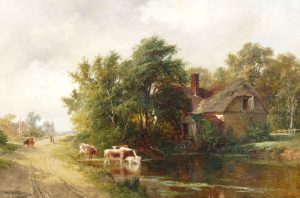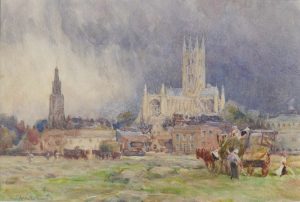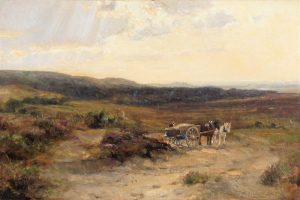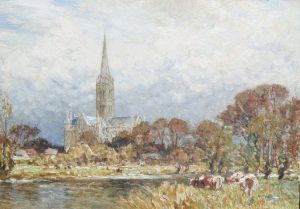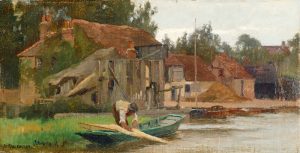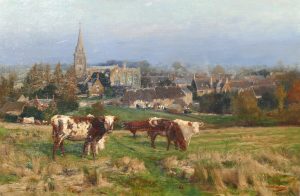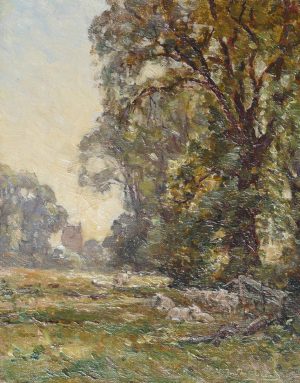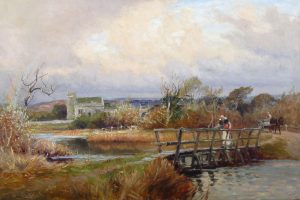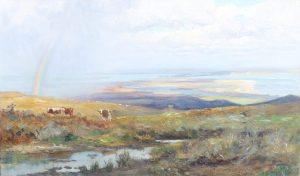
He was a Landscape, still life, architect & portrait painter who was born in Leamington Spa. He studied under John Burgess & Juliens, Paris, and exhibited at the Royal Academy, Royal Society of British Artists (53 works) & elsewhere, examples in Dorchester Museum.
He began to paint in Dorset from 1893 & was influenced by Constable.
“Among the first British impressionists exhibiting art specifically relating to Hardy’s Wessex was Frederick Whitehead.
Working en plein air – directly from nature – – with landscapes viewed through a Hardyean lens- he embraced the Hardy Brand – which was advantageous when exhibiting and selling work in London’s Royal Academy and other galleries.
Critics noted that Whitehead’s work attracted considerable attention outside art circles because of Mr. Hardy’s connection with the county. To further emphasise the point, Whitehead accompanied his work with relevant Hardy quotations, often from Tess or the Return of the Native.
Whitehead knew Hardy and was aware of his writings of the Wessex countryside, he wrote of reading his novels in the evening, relishing the descriptive passages of every hamlet of cob and thatch, and then painitng his landscape settings by day. Whitehead often adopted overt Hardy references in his titles and accompanying text to make the work more commercial.
This nexus between pictures, place and words was sanctioned by Hardy, who so admired Whitehead’s large painting of Blackmore Vale (from Bulbarrow) – that he commissioned a smaller version.
Hardy’s wife Emma painted landscapes explicitly acknowledging Whitehead’s influence, closely copying his work, as in her painting of Bulbarrow (now in the collection of Dorset County Museum), which she inscribed as ‘after Whitehead’.”
Gwen Yarker