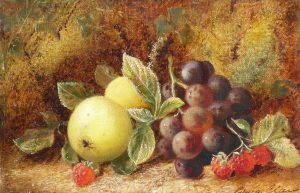
George Clare (1835–1890) was an exceptionally skilled British Victorian painter celebrated for his meticulously detailed, naturalistic still-life compositions. Highly influenced by the art critic John Ruskin’s ethos of scientific accuracy and the stippling techniques of watercolorist William Henry Hunt, Clare abandoned traditional, formal studio setups. Instead, he preferred to portray nature exactly as it was found in the British countryside. Today, he is recognized as one of the foremost English still-life artists of his generation. He initiated an artistic dynasty that heavily influenced late 19th-century British decorative arts.
Born in Barnet, Hertfordshire, Clare initially worked in the decorative trade as a japanner while refining his self-taught painting skills. He moved to the industrial hub of Birmingham in the 1850s, residing in Ladywood and operating a studio on Livery Street. He later lived briefly in Devon before returning to his birthplace of Barnet, where he remained until his death in 1890. Clare passed his specialized techniques down to his sons, Oliver Clare and Vincent Clare, both of whom adopted his distinct naturalistic approach and achieved immense popularity in their own right.
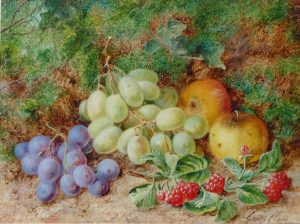
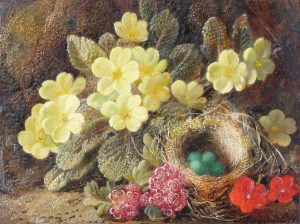
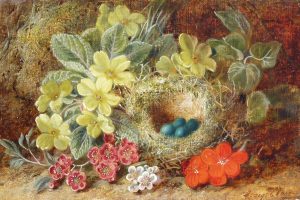
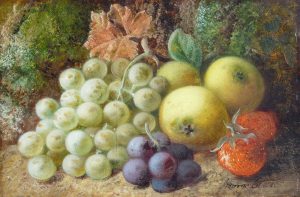
Unlike earlier artists who painted formal bouquets in vases, Clare pioneered the “mossy bank” style. He depicted wild berries, plums, grapes, primroses, and bird’s nests resting directly on the textured ground of the hedgerow. To capture these scenes, Clare used an intricate stippling method, applying paint in thousands of tiny, fine dots. This microscopic approach created unparalleled depth, realism, and a tactile quality that made fruit look life-like. His work resonated deeply with the wealthy Victorian middle class, who valued both the scientific precision of the natural world and the idyllic romanticism of the British countryside.
Clare was a highly respected fixture in the Victorian gallery circuit, frequently showcasing his works at major national institutions. He exhibited multiple major works at the prestigious Royal Academy, including his debut Plums, etc. in 1864, followed by features in 1866 and 1867. He also regularly debuted seasonal flora compositions at the British Institution, and showcased 18 works at the Royal Society of Artists in Birmingham. Today, Clare’s work is held in numerous public and private museum collections across the United Kingdom. It remains highly sought after by fine art collectors worldwide for its vibrant colour, extreme detail, and quintessential British charm.