Prominent watercolour painter of rustic and architectural subjects, engraver, lithographer & teacher. Travelled & exhibited widely.
Harding was born at Deptford in 1798, the son of a drawing-master who had been a pupil of Paul Sandby. He was taught perspective by his father and had lessons from Samuel Prout. At the age of thirteen he exhibited two drawings of buildings in the style of Prout at the Royal Academy.
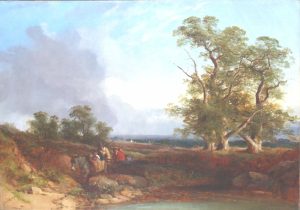
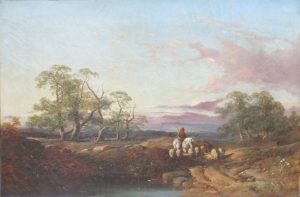
He was apprenticed to the engraver Charles Pye, but left him after only a year to concentrate on painting watercolours, and when he was 18 he was awarded a silver medal by the Society of Arts. In 1818 he showed with the Society of Painters in Watercolours, (known as the “Old Watercolour Society or OWCS from 1831) for first time. He was to contribute to its exhibitions for the rest of his life. He was elected an associate of the society in 1820 and a full member in 1821. In 1843 he took up oil painting, and exhibited many landscapes in that medium at the Royal Academy. In 1847 he resigned his membership of the OWCS , hoping to be elected a member of the academy; but, after nine years without success, he withdrew his candidature, and was re-elected to the OWCS.
From an early on in his career Harding was a successful and popular teacher. When lithography became popular in Britain, he quickly adopted it as a means of reproducing good examples for the use of pupils and students. His first productions were drawing-books, consisting of pencil sketches and studies of trees; they were printed in tints with two stones, allowing the reproduction of more elaborate drawings.
In 1830, Harding exhibited a series of Italian views sketched on papers of various colours and textures, the style of which was widely imitated. His use of opaque body colourin watercolour, following the example set by J. M. W. Turner, also proved influential. His drawings were praised by John Ruskin in Modern Painters. From the 1830s a range of papers was produced under the name of “JDH pure drawing paper”, initially for Winsor and Newton. The papers, which proved popular amongst both amateur and professional artists, and which Harding used himself, were produced in white, and in shades of cream, buff and grey. They were marketed until around 1910. Winsor and Newton also produced pencils under Harding’s name.
He died at Barnes, on 4 December 1863, and was buried in Brompton Cemetery.