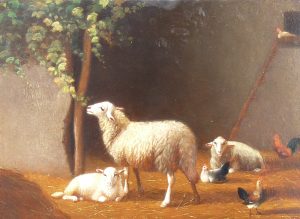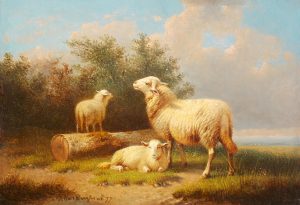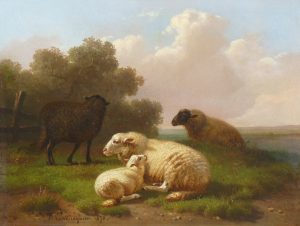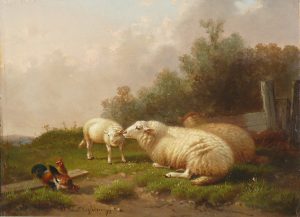
Joseph van Dieghem (Belgian, 1843–1885) was a prominent nineteenth-century animal and landscape painter, celebrated for his idyllic, highly detailed romantic depictions of European rural life. Born in Halle, Belgium, van Dieghem formalised his artistic training at the prestigious Académie Royale des Beaux-Arts in Brussels starting in 1864. He spent the entirety of his productive career working within the Belgian capital, establishing a highly successful niche in the international art market before his untimely death at the age of forty-two.
Working during the peak demand for European pastoral realism, van Dieghem became one of the most dedicated followers of Eugène Joseph Verboeckhoven, the undisputed master of Belgian animal painting. Van Dieghem specialized in intimate, small-scale stable interiors and sun-drenched meadow landscapes. His signature compositions almost exclusively feature resting sheep and lambs, which he paired with precisely rendered poultry, such as chickens and ducks, to add texture and life to the scene. He is highly regarded for his handling of soft, atmospheric light, often casting his pastoral subjects under warm, hazy, pink-hued twilight skies.
Because van Dieghem died relatively young, his total lifetime output remains concentrated and scarce. Despite his brief career, his paintings were heavily marketed globally during his lifetime, with a massive volume of his work being eagerly acquired by prominent nineteenth-century art collectors in the United States and Great Britain. Today, his meticulously executed oils on wooden panels remain highly collectable anchors of classical European art collections. Collectors and curators should note that due to historical transcription variations, his works have occasionally been catalogued under the first name “Jacob” or simply signed with the initials “JB”