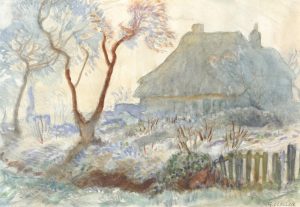
He was a pivotal figure in British art, celebrated for his empathetic depictions of rural life and his mastery of light. Born in London to a Danish decorative painter, he began his career as a draughtsman before winning a scholarship to the South Kensington Schools. His artistic vision was profoundly shaped by his time in Paris at the Académie Julian and his travels through Belgium and Holland, where he adopted the naturalist techniques of Jules Bastien-Lepage.
In 1881, Clausen married Agnes Mary Webster, with whom he had five children. Seeking to capture “direct from nature,” he moved his family to the countryside, living in Berkshire and Essex. There, he became a founding member of the New English Art Club (1886) to challenge the traditionalism of the Royal Academy. However, his immense talent eventually made him a pillar of that very establishment; he was elected a Royal Academician and served as a highly influential Professor of Painting, later publishing his lectures to guide a new generation of artists.
During World War I, at the age of 65, Clausen served as an Official War Artist. The conflict deeply affected him personally and professionally, leading to works like In the Gun Factory at Woolwich Arsenal and the poignant Youth Mourning, inspired by the death of his daughter’s fiancé. Knighted in 1927, Clausen continued to paint until his death at age 92 in Cold Ash, Berkshire. His legacy remains defined by the dignity he afforded his working-class subjects and his lifelong obsession with the atmospheric “glow of the sun.”