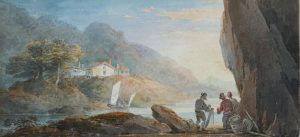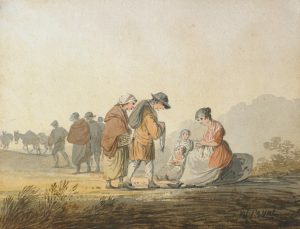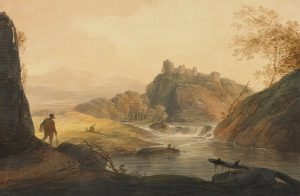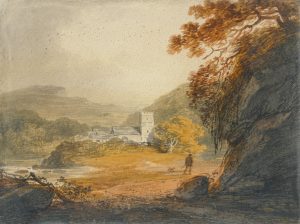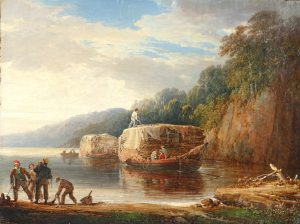
He was one of the most influential and commercially successful watercolourists of the late 18th century. Originally an engineer for the Board of Ordnance in Plymouth, he moved to London in 1790 where he quickly established himself as a fashionable drawing master. His innovative approach to the medium helped transition watercolour from a purely topographical tool into a refined, expressive art form.
He is best remembered for inventing “Payne’s Grey,” a unique tint created from a mixture of indigo, raw sienna, and lake. This signature pigment allowed him to achieve the atmospheric, misty depths and soft shadows that define his style. His work often features the rugged landscapes of Devon and Cornwall, characterized by “split-brush” techniques to depict foliage and a distinct use of sunlight breaking through dark, dramatic clouds.
As a founding member of the Associated Artists in Water-Colours and a contributor to the Old Water-Colour Society (OWS), Payne played a vital role in elevating the status of the medium. His paintings remain highly prized by collectors for their technical virtuosity and their contribution to the Romantic tradition of British landscape painting. His works are currently held in major institutions, including the Victoria and Albert Museum and the British Museum.